
China is significantly expanding its nuclear power sector, aiming to become a global leader by 2030. The country has the capacity to construct up to 50 nuclear reactors simultaneously, reducing reliance on fossil fuels.

'By taking over these reactors, it will ensure Ukraine's supply of electricity is cut off.'

In a major step towards completing its nuclear triad, India has activated the atomic reactor on-board the indigenous nuclear submarine INS Arihant, paving the way for its operational deployment by the Indian Navy.

China has declared that it has acquired the first foreign contract for its self-developed 1000 MW nuclear reactor, hinting that it could be exported to Pakistan, overriding the concerns of both United States and India. ACP1000, a third-generation nuclear reactor developed independently by China National Nuclear Corporation, has secured its first foreign contract, the company said on Friday.

Russia and China are 'seriously' considering a project to install a nuclear reactor on the Moon in the next decade, the official media in Moscow quoted the head of the Russian space corporation as saying.

India's 500 MWe Prototype Fast Breeder Reactor (PFBR) at Kalpakkam in Chennai has achieved first criticality, marking a significant advancement in the country's nuclear energy capabilities and long-term energy security.
Pakistan has started construction of its fourth nuclear reactor at Khushab in Punjab province, signalling its ambitious effort to modernise and expand the nuclear arsenal.
"We have finalised negotiations in regard to reaching an agreement on building additional nuclear power plants in India," Prime Minister Manmohan Singh said in the presence of the Russian Prime Minister. Zubkov affirmed his country's commitment to building the nuclear plants in Kudankulam.
China has secretly entered into an agreement with Pakistan to construct a third nuclear reactor at Chashma in Punjab province that the Obama administration says will violate Beijing's promises under an international anti-nuclear weapons accord, a media report said.
China tacitly acknowledged on Thursday that it will build two new nuclear reactors in Pakistan in a deal that could re-ignite persistent concerns about proliferation and safety of atomic materials in the restive South Asian nation.
Keeping in view the ever-increasing energy requirement, India is all set to establish at least four nuclear reactors besides the world's first thorium-based reactor by 2020.

John Kerry, US Secretary of State, who is here for the 2nd Indo-US Strategic and Commercial Dialogue, said his country would want its civil nuclear cooperation with India to take shape in setting up of reactors.
He emphasised that technology sharing and availability of funding are the two crucial links for ensuring the commercial availability of SMR technology.

Chinese foreign ministry spokesperson, Hua Chunying said China-Pakistan cooperation is in accordance with the 48-member nuclear club, which supervises global nuclear commerce.

In many ways, this is only the beginning -- of a new chapter in India's nuclear story, and of a future where its vast thorium reserves could finally power its ambitions.

'The Atomic Energy Commission has approved the FDI policy and it is going in for ministerial consultations.'

With the regulatory approval from the US Department of Energy in its kitty, Indian multinational conglomerate L&T is planning to focus on manufacturing small modular reactors (SMRs) to play a leading role in the commercialisation of nuclear energy in India.

Bill Gates is said to be considering investing personal assets worth several hundreds of billions of yen in developing the new type of reactor.
Researchers at IIT Guwahati have developed a method to enhance cement mortar, making it stronger, more durable, and capable of blocking harmful radiation, with the goal of improving the safety of nuclear facilities.
The decision was taken along with six partner countries backing the so-called International Thermonuclear Experimental Reactor project.
Baldev Raj, scientist and director, Indira Gandhi Centre for Atomic Research, Kalpakkam, said the current installed nuclear power generation capacity is likely to increase five-fold to 25,000 Mwe by 2050 from the current 3,900 Mwe. The proposed expansion would require over Rs 125,000 crore. Nuclear power accounts for 3 per cent of India's total electricity generation and is estimated to go up to 25 per cent in 2050.
The Supreme Court is reviewing a plea challenging the 2025 SHANTI Act, which caps liability at Rs 3,000 crore for nuclear plant incidents, raising concerns about victim compensation and operator accountability.

Fuel loading at India's first prototype fast-breeder reactor in Kalpakkam is expected to start next week, marking a significant step in the country's nuclear program.

India and Canada solidify their partnership with a landmark uranium supply agreement and discussions to finalise a comprehensive economic partnership, signaling stronger ties and cooperation on key global issues.

Prime Minister Narendra Modi and US President Donald Trump have vowed to move forward with plans to work together to build US-designed nuclear reactors in India. The decision was made during their meeting at the White House, where they also agreed to significantly expand energy cooperation. The move comes after India announced plans to amend its nuclear liability law and the Atomic Energy Act, which had previously been obstacles to the implementation of the US-India civil nuclear deal.

India and Russia are expected to unveil a major nuclear energy partnership during Vladimir Putin's visit, potentially involving Russian small modular reactors and expanded cooperation as India pushes toward its 100-GW nuclear goal by 2047.
Apsara has played a key role in research in areas as diverse as forensic science and the study of lunar and meteorite fragments.

'We were in a heavily nuclearised environment. China had tested for Pakistan in the 1980s and helped their missile programme stay just one step behind us.'

The RusBeam 2800 is now India's largest electron-beam wire deposition 3D printer operating under vacuum. The machine was custom-built for India and is operated with software developed by Rosatom.
This would make India the world's second-biggest nuclear energy market after China

The US-China rapprochement, however tenuous, is not without implications for India. Both China and Pakistan have become closer to the US, notes Ambassador T P Sreenivasan.

India's nuclear energy share in total installed capacity remains limited, fluctuating between 1.9 per cent and 2.9 per cent from FY10 to FY24.

The operator's liability in the case of an incident is limited to 3,000 crore for reactors with thermal power above 3,600 Megawatt; 1,500 crore for reactors with thermal power between 1,500 Mw and 3,600 Mw; 750 crore for reactors with thermal power between 750 Mw and 1,500 Mw; 300 crore for reactors with thermal power between 150 Mw and 750 Mw; and 100 crore for reactors having thermal power up to 150 Mw, fuel cycle facilities other than spent fuel reprocessing plants and transportation of nuclear materials.

Construction major L&T is gearing up to expand its footprint in the global nuclear supply chain, a senior company official has said, while calling for amendments to key legislations on the domestic front to pave the way for the entry of private players and foreign capital necessary for capacity enhancement.

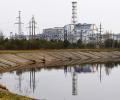
Forty years ago a reactor at the Chernobyl Nuclear Power Plant in Ukraine tore itself apart during a failed test, triggering the worst violent release of radioactive debris into the atmosphere.

Through his commitment to democratic norms, debate, dissent and constitutionalism, Jawaharlal Nehru helped ensure that parliamentary democracy took deep root in independent India. Utkarsh Mishra evaluates Nehru's 17 years as India's first prime minister, examining his role in nation-building, democratic institution-building, economic planning, scientific advancement and foreign policy.
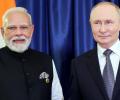
The Russian cabinet has cleared the signing of a memorandum of understanding (MoU) to deepen bilateral cooperation with India in civil nuclear energy during President Vladimir Putin's visit to the country.

US President Donald Trump's call to Prime Minister Narendra Modi signals a concerted effort to reset strained Washington-New Delhi ties, with a focus on 'big-ticket' energy and trade deals, including increased Indian imports of US LNG and LPG, and potential cooperation on small modular reactors.

The operation reportedly extended to American assets, with the IRGC claiming that "US military bases in the region, namely Ali al-Salem in Kuwait, as well as al-Minhad and al-Dhafra in the United Arab Emirates, were also targeted."
The Bill is likely to pave the way for amending two existing legislations -- the Atomic Energy Act 1962, and the Civil Liability for Nuclear Damage Act 2010.
